


Good nutrition, combined with physical activity, is vital for a healthy lifestyle. Poor eating habits lead to obesity and major health risks like cancer, heart disease, and diabetes. We are going to look at how to eat better and ensure you are getting a proper balanced diet.
Food Groups
By following the USDA recommended daily servings for each food group, you can create healthy eating habits that meet your body’s nutritional needs. The 5 basic food groups are:
- Vegetables
- Fruits
- Grains
- Proteins (Meat, Poultry, Seafood, Nuts, Eggs, Beans)
- Dairy
In addition to these groups you might periodically see sweets/sugars and fats/oils listed as other groups. You should only eat foods from these groups sparingly.
Vegetables
The recommended daily servings of vegetables for men is 2.5 to 3 cups and for women 2 to 2.5 cups. Try to eat a variety of types and colors to get a variety of nutrients.
Fruits
For men the USDA recommends 2 cups of fruit, while women need 1.5 to 2 cups per day. A 1 cup serving is equal to 1 cup of chopped fruit, 1 cup of 100% fruit juice or 1/2 cup of dried fruit. Whole fruits are preferred since the skin and pulp provide more fiber and nutrients. Watch out for added sugar in fruit juice or frozen fruit.
Grains
The daily recommendation of grains for men is 6 to 8 oz equivalents and for women is 5 to 6 oz equivalents. A 1-ounce equivalent is 1 cup of cereal, 1/2 cup of cooked rice or pasta, or 1 slice of bread. You should get at least half your daily servings in the form of whole grains because refined grains like white rice or white bread lose nutrients and more importantly the fiber.
Proteins
Members of the protein group include meat, poultry, fish, and eggs. It also includes soy products, nuts, seeds, beans, and peas which are all also considered vegetables. For men the daily serving recommendation is 5.5 to 6.5 oz equivalents and for women 5 to 5.5 oz equivalents. A 1-ounce equivalent equals 1 oz of lean meat, fish or poultry, 1 egg, 1/2 oz of nuts or seeds, and 1/4 cup of cooked beans.
Dairy
Men and women should both get 3 cups of dairy daily. For non-fluid dairy products a 1-cup serving is equal to 1.5 oz of hard cheese, 2 oz of processed cheese, 1/2 cup ricotta cheese, and 2 cups of cottage cheese. The dairy group is made up of food items that are made from milk and retain their calcium content, which is important for bones, like yogurt, cheese, and ice cream. It does not include dairy products that lose their calcium content like butter and cream.
MyPlate
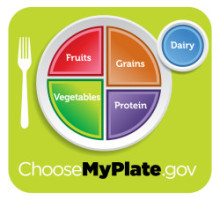
Another way of looking at the way you eat is MyPlate. It has replaced the food pyramid as the way the US government represents what you should eat.
Eating the MyPlate way means filling half your plate with vegetables and fruits, adding slightly more veggies than fruits. Go for a colorful mix and you’ll get plenty of nutrients. You should fill the other half of your plate with lean protein and grains, using slightly more grain than protein. You would also add in a side of dairy (shown as a glass of milk in the MyPlate icon).
Calories
When addressing losing weight (or gaining weight ) from your diet then the best way is to count calories and adjust your daily intake.
Calories are simply a unit of measurement for the amount of energy a food or drink contains. Foods are made up of carbohydrates, protein, or fats. A gram of carbohydrates or protein has 4 calories, while a gram of fat has 9 calories.
Your body uses calories for energy and basic bodily functions regardless of physical activity. Obviously the more physical activity you do during the day the more calories your body needs. Thus the calories you eat will either be turned into energy and used or if you eat more calories then your body needs it will get stored as fat. Once stored the only way to use up that fat is by reducing your caloric intake so that your body draws on that fat reserve for energy or by increasing physical activity so that you burn more calories and fat per day.

This chart shows the average baseline amount of calories a person needs depending on age, sex, and activity level. While this is the average, it can also vary quite a bit depending on height.
Since 3500 calories equal about 1 pound, if you want to lose 1 pound then you need to burn or cut 3500 calories more than you consume. This could come from reducing your daily intake of calories from your baseline by 500 each day, which would result in a 1 pound loss in 1 week. Although weight loss is more complex than this, so it rarely is this simple.
To determine how many calories you currently eat you should write down everything you eat for one week. Add up the calories to establish your current daily caloric intake. You can then adjust your intake to account for either a standard amount where you won’t gain weight or a lower than baseline diet in order to lose weight. If you are an adult you should never go below 1200 calories per day. Below this point you can significantly slow down your metabolism and long term your body will store more fat.
Summary
In summary the key to a good diet is eating the recommended daily servings from the 5 major food groups. If you want to lose weight you need to reduce your caloric intake below your baseline calorie level.
Continue reading the Complete Guide to Getting Fit Part 4 – Exercise


